
Palm Beach County Court Records After a Jail Arrest
In Palm Beach County, the path from an arrest to a court record runs through several offices. The Sheriff books the person into jail. The Office of the State Attorney for the Fifteenth Judicial Circuit reviews the arrest and decides what to charge. The Clerk of the Circuit Court then opens and keeps the criminal case file. That case file is the court record, and it is the document that tells you what charges were filed and how the case is moving.
It helps to keep the two sides separate. For the booking and custody side, the jail inmate records page covers the roster, and the jail mugshots page covers booking photos. For the court side, you want the charges the prosecutor filed after the arrest, which are tracked through the case rather than the jail roster.
How to Find Palm Beach County Court Records After an Arrest
The Clerk runs an online case search called eCaseView, reached from the Clerk's court records search page. The portal itself is eCaseView, where charges and charge status appear once a case is filed. Arrest and booking detail stays on the jail roster, so use the court portal for the charges and the disposition.
- Open eCaseView from the Clerk's court records search page.
- Search by the defendant's name or by the case number if you have it.
- Open the matching case and read the charge list filed by the prosecutor.
- Check each charge for its code, level, and current status.
For a statewide record rather than a single county case, the Florida Department of Law Enforcement runs a criminal history check that searches across counties. That check carries a fee and is not the same as a live court docket.
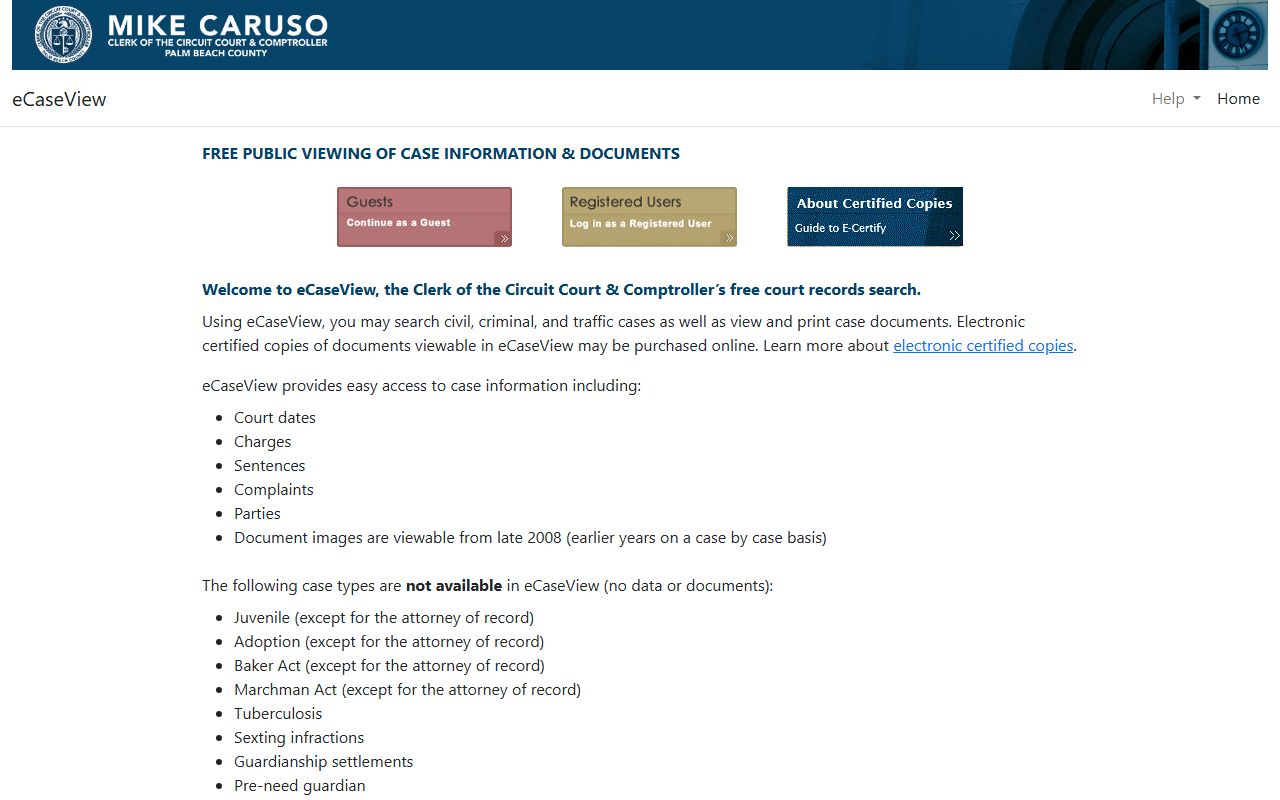
The eCaseView interface above is where the filed charges, hearing dates, and dispositions live for a Palm Beach County criminal case.
How Charges Get Filed After an Arrest: Complaint, Information, and Indictment
Walk the case forward from the arrest. Booking happens at the jail, and then the court record begins when the prosecutor files a charging document. Florida prosecutors file by information for most felonies, while a grand jury returns an indictment for the most serious cases. The document that opens the case is what gives it a case number in eCaseView.
| Complaint | Information | Indictment | |
|---|---|---|---|
| Filed By | Officer / prosecutor | State Attorney | Grand jury |
| Common For | Misdemeanors | Many felonies | Serious felonies |
| Starts | The case | The case | The case |
The decision to charge belongs to the State Attorney, led in this circuit by Alexcia Cox. That office, separate from the Sheriff who books the arrest and the Clerk who keeps the file, is described on its official site.
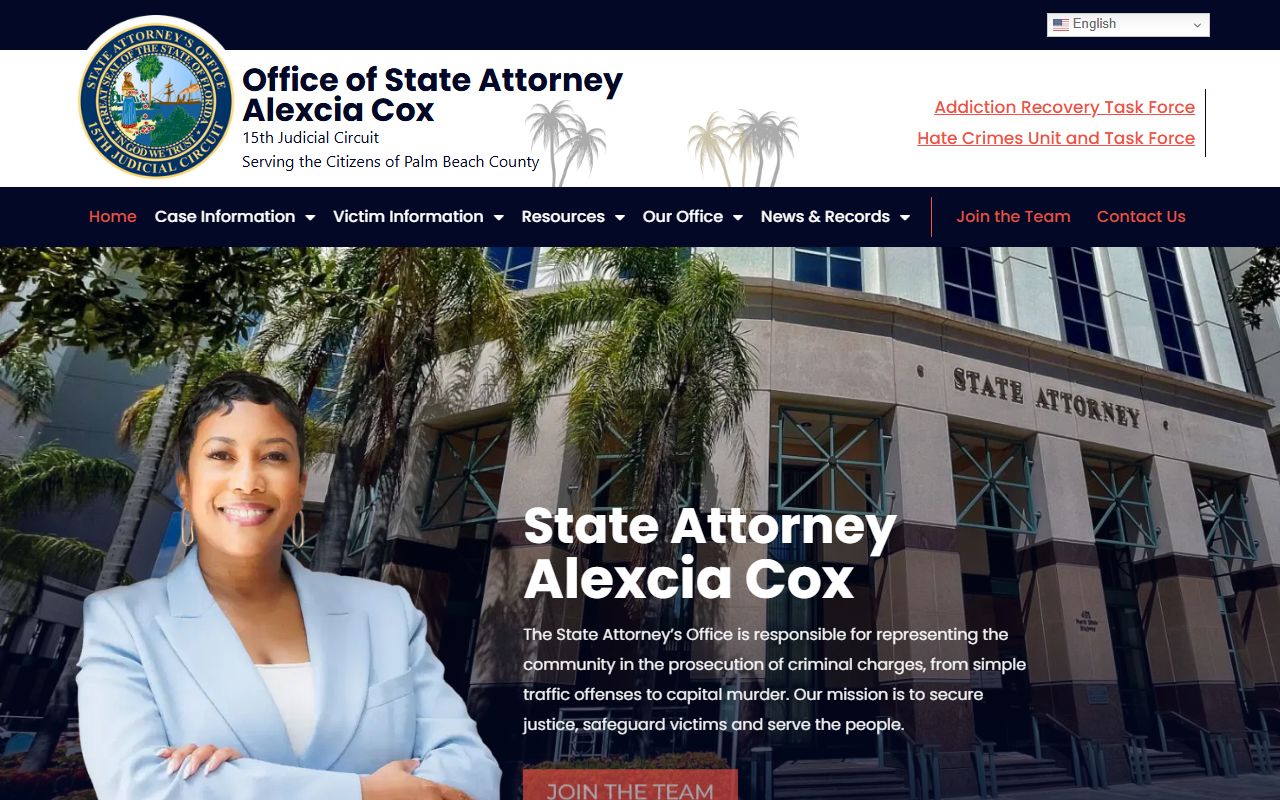
The prosecutor reviews the arrest reports and evidence before charges are filed, which is why the court record can differ from what the roster listed at booking.
Charge Status in the Court Record After an Arrest
Charges change as a case moves. A charge can be amended, reduced, added, or dropped, and the booking charges on the jail roster can differ from what the prosecutor finally files. The status terms below appear in eCaseView and tell you where a charge stands.
| Status | What It Means |
|---|---|
| Pending | The charge is filed and the case is still moving through court. |
| Amended / reduced | The prosecutor changed the charge, often to a lesser offense. |
| Dismissed | The charge was dropped and is no longer being pursued. |
| Nolle prosequi | A formal prosecutor decision not to proceed on the charge. |
Note: A charge listed at booking is not a conviction, and a dropped or reduced charge is common, so read the court record rather than the arrest record for the outcome.
What a Palm Beach County Court Record Shows
A criminal case file in eCaseView holds far more than a single charge. It tracks the case from filing to disposition, with hearings and filings recorded as docket events. The fields below are the ones people read most often when they pull a court record after an arrest.
- Case number, defendant name, and court division.
- The charges, with offense descriptions and statute numbers.
- Docket events and scheduled court dates.
- The judge or courtroom, when public.
- The disposition, such as pending, dismissed, nolle prosequi, a plea, or a sentence.
- Bond and custody events, plus documents available for public viewing.
Confidential and sealed documents do not appear in the public view, even when the case itself is listed. For records the portal does not show, the Clerk accepts in-person and written requests.
Bond and Release After an Arrest
Bond is set early, usually at first appearance, where a judge addresses probable cause and release conditions. Bond decides custody while the case proceeds. It is not the case outcome, and a hold from another agency can keep a person in jail even after a local bond is paid. The table sorts the main bond types.
| Bond Type | How It Works |
|---|---|
| Cash bond | The full amount is posted in cash or accepted funds. |
| Surety bond | A licensed bail agent posts the bond for a fee. |
| Recognizance (ROR) | Release on a promise to appear, set by the court, not the website. |
| No-bond hold | The person cannot be released by paying a listed amount, often due to a warrant, a violation, or a hold. |
Confirm the booking and whether a bond is actually set before paying anything, and check whether a detainer or out-of-county hold would keep the person in custody anyway.
Warrants That Lead to an Arrest
Many arrests start with a warrant. A judge signs an arrest warrant for a criminal charge, while a bench warrant or capias is issued by the court, often for a failure to appear. A capias is simply a court order for arrest. When a person is booked on a warrant, the roster may show the related charge or hold, and a no-bond status can block release. The Sheriff's Warrants Unit is the official contact point, though Florida sources do not provide a single public countywide warrant search. The underlying case and any capias usually show up in eCaseView, so the court record is the better place to confirm a warrant tied to a case.
The channels for warrant information stack up in a clear order. The Sheriff's Warrants Unit handles official warrant contact, eCaseView shows bench-warrant and capias docket events in county cases, and a public-records request covers nonexempt warrant or arrest records. A statewide FDLE criminal-history check is not a live warrant tool. Anyone who believes they have an active warrant should not treat a website as legal advice and should contact an attorney or the issuing court before acting.
Charges vs. Convictions
Being arrested and charged is not the same as being convicted. A charge is an accusation that rests on probable cause. A conviction comes only after a plea or a verdict that meets a much higher standard.
| Charge | Conviction | |
|---|---|---|
| Stage | Accusation | Verdict or plea |
| Burden of Proof | Probable cause | Beyond a reasonable doubt |
| Public Record | Yes | Yes |
This is why a court record can show a charge that ended in a dismissal or an acquittal. The record of the arrest stays, but the result is what tells the full story.
Sealed vs. Expunged Records After an Arrest
Florida lets eligible people seal or expunge a record after a qualifying disposition, such as a dismissal. Sealing hides the record from general public view. Expunction goes further and has the record destroyed or treated as if it never existed. Eligibility is set by statute and is narrow, so the route runs through the courts and the state, not a website.
| Sealed | Expunged | |
|---|---|---|
| Visibility | Hidden from public view | Destroyed or treated as never existed |
| Law Enforcement | Limited access remains | Very limited access |
| Eligibility | Florida Statutes § 943.059 | Florida Statutes § 943.0585 |
The court and criminal-justice records exemption rules under Florida Statutes § 119.0714 explain why some case data is kept out of public view even before any sealing.
Background Check Considerations
There is a real difference between a casual name lookup and a regulated background check. A formal background check for hiring, housing, or credit must follow the Fair Credit Reporting Act and use a licensed consumer reporting agency. A public-record lookup does not meet that standard and cannot be used for those decisions.
Important: This site is not a consumer reporting agency under the FCRA, and nothing here may be used to screen for employment, housing, credit, or insurance.
Restricted Court Records After an Arrest in Palm Beach County
Not every record tied to an arrest is open. Juvenile records are confidential under Florida Statutes § 985.04. Sealed and expunged charges are removed from public view. Ongoing investigations, victim-protected information, and certain confidential material can also be withheld. When a case or charge does not appear in eCaseView, an exemption may be the reason, and a public-records request to the right office is the next step. For a statewide picture rather than a single county file, the FDLE criminal-history check pulls records across Florida for a fee, while the State Attorney's office handles prosecution and victim-witness matters rather than general custody questions.